We’ve all heard the name: Kanye West. An enigma amongst contemporary rappers and artists in general. An eccentric with a little bit of a bit of an unstable mind, Kanye West has recently been in the news because of his views on politics. I’m not going to get into that here, but I do want to set the stage for one of the most interesting minds in music today. A lot of people (not me) divide Kanye into two parts: The music side of him, and the rest of him. Now me, I try to look at all parts of him at once, and to be honest it only gives me more appreciation for him.
As an artist myself, I sometimes find it hard to express in the best way the emotions I’m feeling. This is either because of me lacking the vision of how I would translate these emotions into a song or sometimes I just feel that the medium of putting your art onto an album isn’t enough. Well, not that it’s not enough, but it is what is – meaning it is what it is and it’s not going to change. There’s a format to these things, a standard if you will. Kanye West’s The Life of Pablo was a landmark in modern music (especially in Hip-Hop), and the reason for that is due to the strange editing process West underwent throughout the subsequent weeks after its initial release.
After the initial release of The Life of Pablo, Kanye put his album through multiple changes. This includes adding songs, adding parts to songs, dividing songs in half making them 2 songs, remixing the songs to make them sound higher quality, etc. This album was his baby, something he could groom and grow up with and add to without taking the original essence away. For example, on “Father Stretch My Hands” Kanye added layers of a gospel choir that wasn’t on the original. With streaming services like Apple Music and Spotify, artists are able to edit whatever part of their work they want, and Kanye was really the first to exploit that.
But more than the changes made to it, the relevance and idea of the album are groundbreaking if you ask me: The Life of Pablo. Who exactly is Pablo? Well, I think we could guess that it’s probably Kanye, but which Pablo? Let’s see what Kanye had to say:
“Which Pablo? Pablo Picasso, Pablo Escobar of course, Apostle Paul. [Paul] inspired and was the strongest influencer of Christianity. Pablo Escobar was the biggest mover of product, and Pablo Picasso was the biggest mover of art. And that mix between message, art, and product is The Life Of Pablo”
You could see that Kanye was trying to go for gold on this project, he was trying to make the greatest project he had up to this point. I get so inspired by listening back to this album and putting myself in the time when it came out because he didn’t need to do this. This was going to be his seventh album, and to think that somebody could stay so hungry for greatness, even after already having been deemed great. It’s an amazing feat and his efforts are definitely shown in how he captures the modern day era. Take the second and third song from the project: “Father stretch my Hands Pt.1” and “Pt. 2”.
Father Stretch My Hands Pt.1
Sampling Pastor T.L Barret’s “Father Stretch My Hands”, Kanye uses the gospel influence he’s had throughout all of his albums, (dating back to even The College Dropout his debut project) and blends his style together with a number of the greatest producers in the game today. Among the producers on this super track are Metro Boomin, Rick Rubin, Mike Dean and of course Kanye West. I mean how much better can you get honestly. I’m guessing each of them had a particular thing to do with the song: Kanye probably found the sample, Metro the drums, Dean the synths, and Rubin probably just the overall recording mix.
He starts the song with the iconic gospel sample (something Kanye finds best) only to be followed by some of the most menacing synths ever to be put on record. The grandeur is already there and gets taken to another level after “If young metro don’t trust yo I’m gon’ shoot you.” Metro Boomin’s tag never sounded so good :’-).
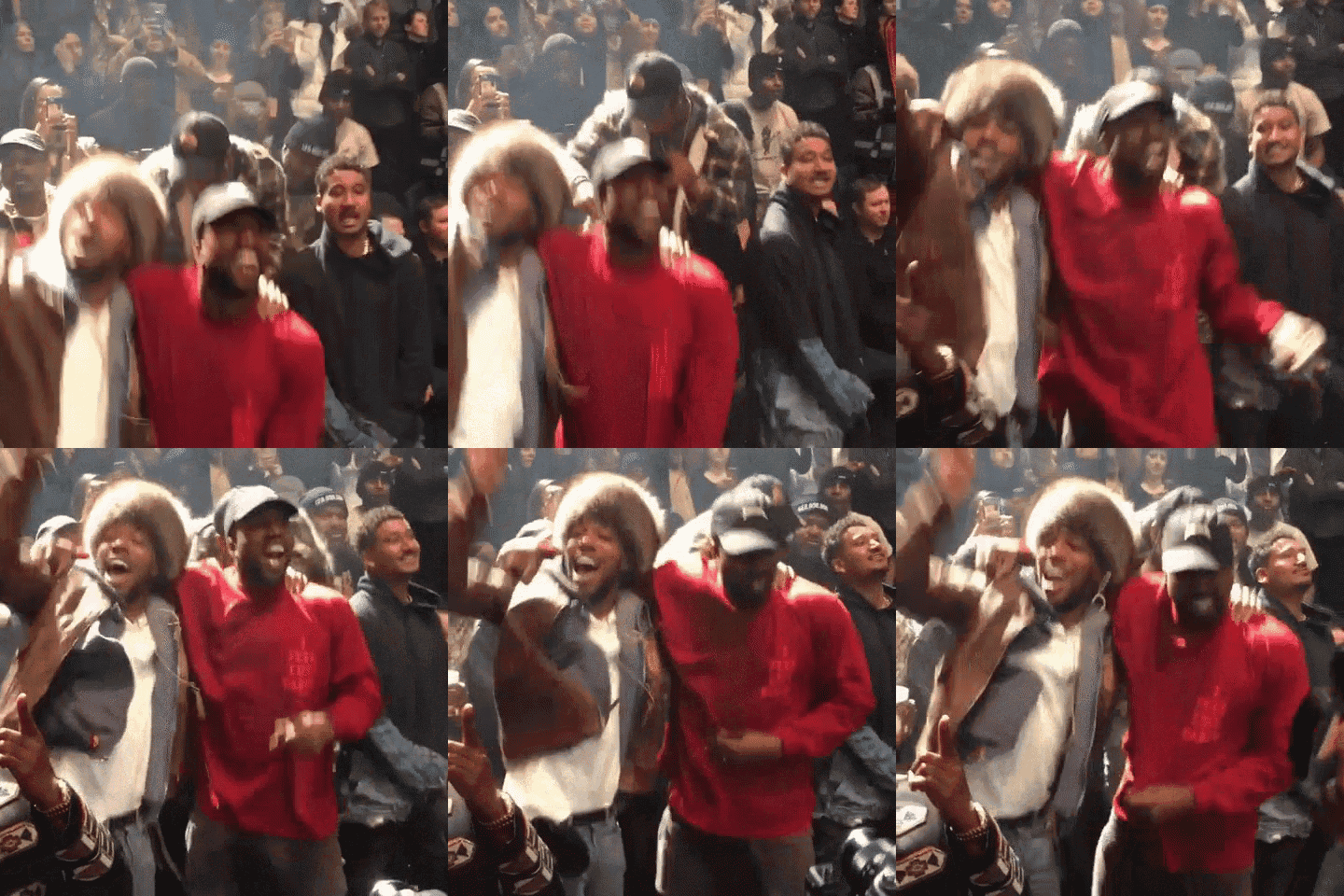
Kanye West and Kid Cudi premiering TLOP at Yeezy Season 3 at MSG
The chorus comes in with Kid Cudi doing his thing as always: “Beautiful mornin’, you’re the sun in my mornin’ babe.” An inspiring chorus, I think referring to that Holy Muse that is also referenced on other gospel tracks. I think with this song Kanye was trying to express his need and want for something Holy. He doesn’t see it enough especially with the fame that he has. I mean just listen to his first verse (I apologize of the explicitness, I didn’t write it).
Now, if I f*ck this model
And she just bleached her a**hole
And I get bleach on my T-shirt
I’ma feel like an a**hole”
Its obviously a silly line, and I think it was like that on purpose. Why else would you juxtapose that Angelic intro with something so comedic and trivial? It was to put you into his headspace, and maybe the headspace of many artists in the spotlight. A headspace focused on the menial things that come with fame and this world, but nothing otherworldly, nothing profound. I think Kanye was trying to put his soul on record here, he was trying to show us that what goes on in his mind is: “I just want to feel liberated I-nanana.” He’s a vulnerable, conflicted, confused soul. But something great about him is his ability to convey it, especially in a way where the message of the song is a by-product, meaning, you can enjoy the song as it sounds without ever necessarily delving into the lyrics and song content.
Pt. 2
Kanye does a complete 180 on us turning the sample into a higher tempo dance track. At about the 40-second mark we can an inclusion of Desiigner’s panda You may all remember the song, but if you don’t let me explain why the inclusion of it on this album is so genius. Like I said before I think Kanye was trying to make an album that captured the times in a nutshell. Before this album was released “Panda” was out already but it hadn’t become the big song that it eventually became. You could attribute that to probably Kanye putting the song on his highly anticipated album. Although i remember not liking the “Panda” sample at first. I thought he was stealing it, like it wasn’t necessary. But after reconsidering why he would do something like that, it became clear to me that all he was trying to do was create a time capsule with this album. I mean just look at the cover:

You see at the top left a family of what looks like a wedding of two African American families (rumored to be his family although that’s never been confirmed) and on the bottom right a photo of the swimsuit model Sheniz Halil. I think that the latter is supposed to remind us at least a bit of Kim Kardashian (the fake butt, if I had to spell it out for you), but its an odd juxtaposition with the photo at the top. To me, this cover is Kanye’s expression of his condition at least in a minimalistic way (the detail comes out throughout the album). It looks like Kanye dealing with a split between the two: His roots, his family, his identity at the top – and then the modern era, his wife, the industry game that he is in a way married to at the bottom. the copied and pasted “Which / One” all along the album making it clear that he trying to choose between the two. All of these things come out on the album and especially on the tracks that I put on display here in this blog.
This album showed me that you could still make music that is “of the times” while being simultaneously aware of it. I thought that this accomplishment was only relevant to artists of previous eras, but Kanye shows us that it’s still possible to be an artist in its truest sense. As much as this cover (and album for that matter) is about Kanye West’s personal battles and situation, it’s also relevant to the everyday person. This new age, with all of its technological innovation, artistic expression, and complexity, seems to be something of another nature when compared to our roots – simplicity, order, familiarity. Now I know that I’ve only scratched the surface with the content of this album and I encourage everyone to listen to TLOP all the way through to catch all of the motifs and themes that I brought up, but I want to make it clear that to me this is probably Kanye’s most conscious work. I think its probably his opus, but that doesn’t mean that its only about him. The Life of Pablo is as much relevant to our lives as it is Kanye’s.

 My Sound Science